Some of the critical limitations/problems that we are solving:

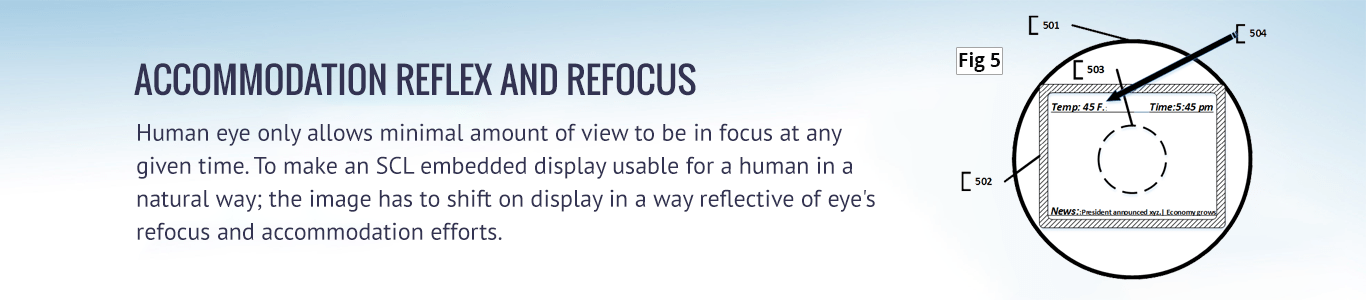
I. Accommodation reflex and refocus: The human eye only allows a minimal amount of view to be in focus at any given time. Humans, and most other mammals, visually perceive using both peripheral and direct (focused) vision. Peripheral vision is not a focused view and normally allows for contour and shape-based perception, which the brain uses to build a 3D model of reality. But for more intimate and proper data ingestion, eyes move (accommodate). Humans have up to two degrees of visual angle (focused vision).
Normally, eyes accommodate by changing their gaze vector to point to different portions of an image, bringing parts of interest into focus for detailed data ingestion. Since the embedded display is spatially associated with, and locked in the same position relative to, the cornea of the eye, and the disposition of an image on the embedded display is a priori stationary relative to the eye – no amount of eye movement would allow the eye to accommodate and refocus.
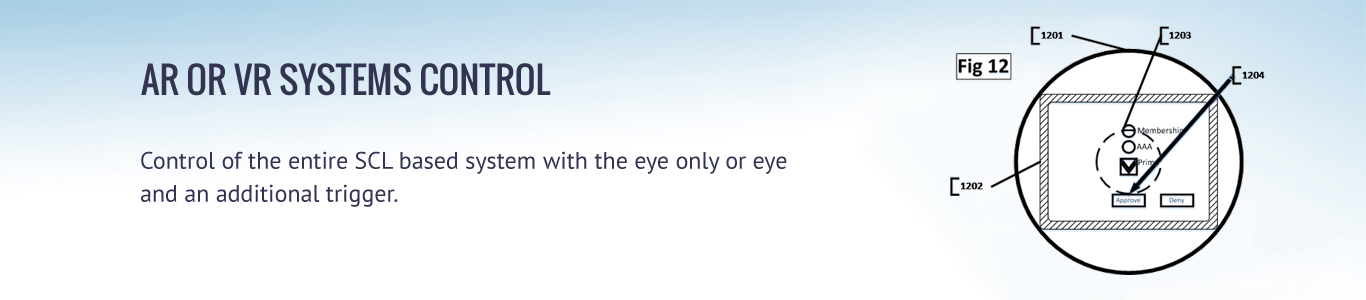
II. AR or VR systems control: Control of the SCL-based system is in question. Monitoring body movement may require dedicated sensors to track eyes, hand gestures, and geometry around the user and changes in his/her environment.
iii. The power supply required and the amount of real-estate space available on contact lenses are big limiting factors for the creation of a powerful and multifunctional system.
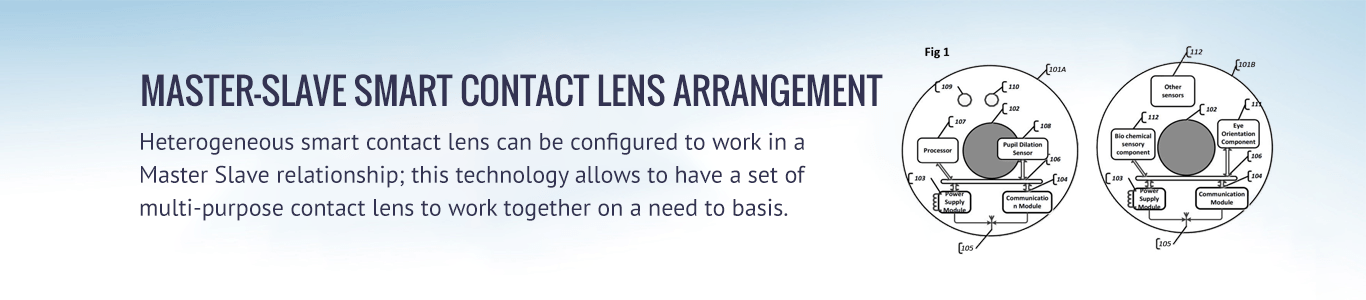
IV. When two smart contact lenses are used, they need to be able to talk to each other and coordinate their activity as one system.
Some Highlights of Our Key Solutions Are:
1) If the image superimposed on the display does not move, and contact lenses with the display are locked into a stationary position relative to the eye, no amount of eye movement will accommodate the refocus on another part of the image. Hence, we propose to shift the responsibility for bringing parts of an image overlaid into focus from the eyes to the display. Hence, our “patent pending” technology:
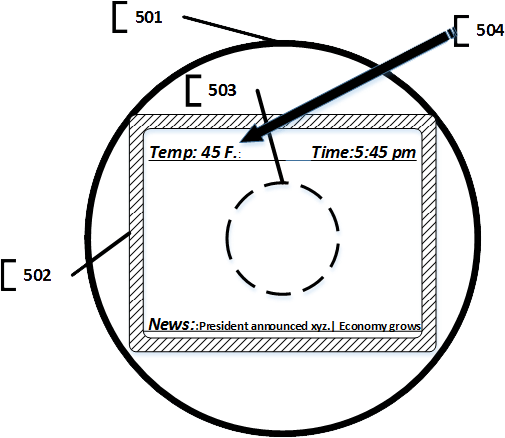

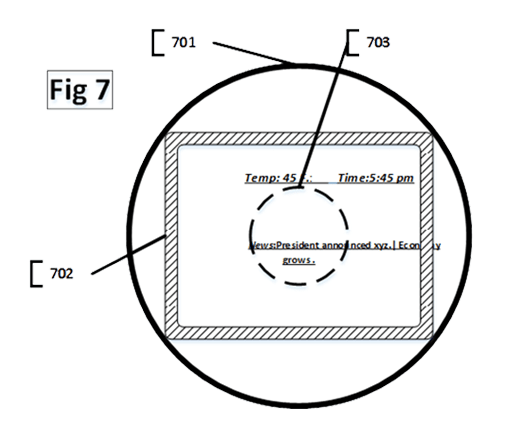
With our unique “patent pending” technology, we propose to track both eye movement and focus. Attempted accommodation tracking allows us to determine if the focus is on the image on display or an external object. If the eye attempts to focus on an image on display and moves its position, the system will move the image on display to position the sought part of the image at the center of the embedded display. Thus, bringing that part of an image into focus.
Our technology also differentiates between 2D and 3D frames of reference relative to which the position of the image on display may be shifted. The 2D frame of reference refers to display geometry where an image is not geometrically linked to the external geometry, such as in the example diagram, which shows a timer, temperature indicator, status indicator, and the running news text. Those may be overlays at the perimeter of the display.
Parts of an image may be brought into focus if the user focuses on and shifts his/her eye position to accommodate. In the 3D frame of reference, the disposition of the image on display may be computed relative to external geometry. For example, if the annotation describes the object in front of the user and the user moves their head/eyes, the annotation needs to remain stationary relative to the external object. Hence the annotation position shifts on the display accordingly.
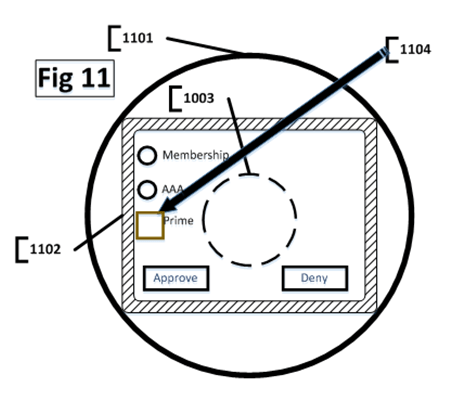
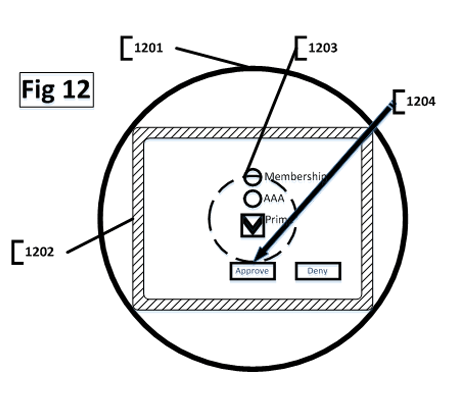
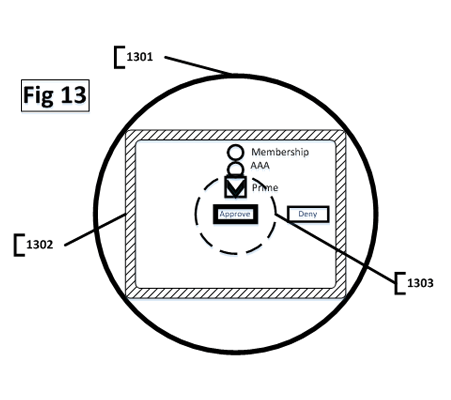
2) Control of the smart contact lens system: Our “patent pending” technology proposes an eye-driven contact lens-based control method.
The system tracks eye orientation and focus, allowing users to select and optionally trigger a UI component with the movement of their eye. This technology allows the user to control any application with the eye only. Optionally, the system may be configured to use gestures, voice control, or other means to perform triggering actions.
3) To make smart contact lenses useful the pair of contact lenses need to be combined in a cooperative fashion; hence our “patent pending” technology, the master-slave arrangement for the contact lens, where communication occurs either directly between the two contact lenses or via an intermediate controlling subsystem. Communication may be performed either with a light-emitting component and a light-receiving optical component or with RF radiation and corresponding integrated antenna.
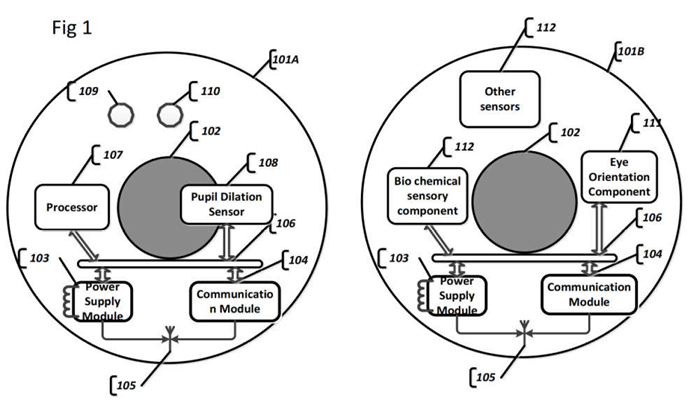
The master-slave arrangement allows the contact lens to be heterogeneous. Each contact lens may come with a differing set of sensors and functions, increasing the system’s overall capability. This allows the system to be more robust, provided the limitations of real-estate on each contact lens and power consumption limits due to size.
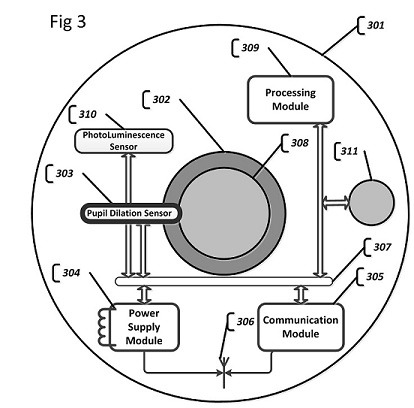
4) One element of the unique “patent pending” technology we are proposing is an integration of an orientation module into the contact lens. Through this, an orientation vector may be determined as a two-dimensional or three-dimensional vector.
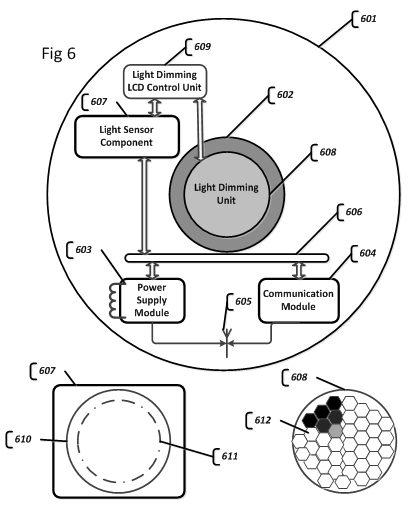
5) Another element of our unique “patent pending” technology enables smart contact lenses to be used instead of sunglasses. In this case, the contact lens system integrates a layer of light dimming unit and a variety of incident or ambient light sensors. Once the angle of the incident light is determined, parts of the contact lens most “affected” by direct sunlight will be dimmed. Different sections of the contact lens may be dimmed differently depending on the intensity of incident light.
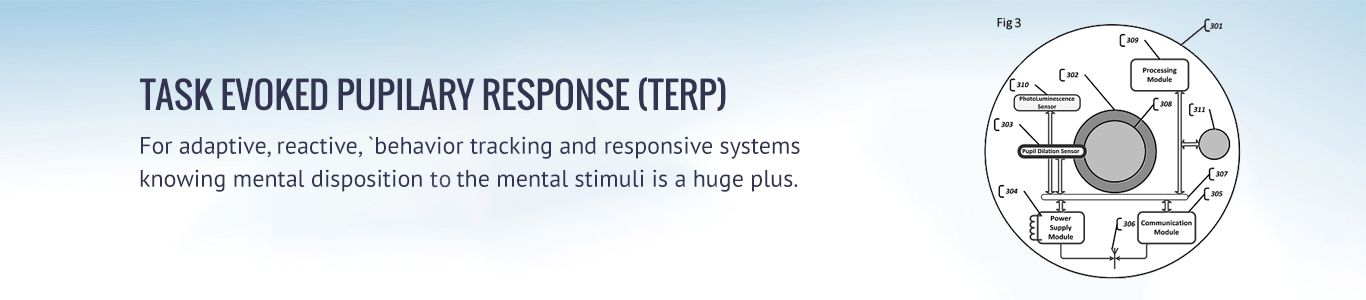
6) Furthermore, we propose unique, unprecedented “patent pending” technology for smart contact lenses that determines TERP (task-evoked pupillary response), which is essentially an indicator of the mind’s disposition toward mental or emotional stimuli at hand. This feature is immensely useful for adaptive, reactive, and behavior-tracking systems and applications.